Не попадитесь на накрученные каналы! Узнайте, не накручивает ли канал просмотры или
подписчиков
Проверить канал на накрутку


Телеграм канал «Wallet News»
#41

Wallet News
820
5.4K
7.9K
3.0K
239.3K
Crypto Wallet is a convenient and safe service to buy, store, and send cryptocurrencies. Posts are not directed towards UK consumers.
Open Wallet @wallet
Our service channel: telemetr.me/wallet_status
Our community: telemetr.me/wallet_news_en_chat
Open Wallet @wallet
Our service channel: telemetr.me/wallet_status
Our community: telemetr.me/wallet_news_en_chat
Подписчики
Всего
3 365 555
Сегодня
-159
Просмотров на пост
Всего
66 585
ER
Общий
1.98%
Суточный
1.34%
Динамика публикаций

Telemetr - сервис глубокой аналитики
телеграм-каналов
телеграм-каналов

Получите подробную информацию о каждом канале
Отберите самые эффективные каналы для
рекламных размещений, по приросту подписчиков,
ER, количеству просмотров на пост и другим метрикам
рекламных размещений, по приросту подписчиков,
ER, количеству просмотров на пост и другим метрикам

Анализируйте рекламные посты
и креативы
и креативы
Узнайте какие посты лучше сработали,
а какие хуже, даже если их давно удалили
а какие хуже, даже если их давно удалили

Оценивайте эффективность тематики и контента
Узнайте, какую тематику лучше не рекламировать
на канале, а какая зайдет на ура
на канале, а какая зайдет на ура
Показано 7 из 820 постов
Смотреть все посты
Пост от 23.10.2026 15:02
7 191
0
8
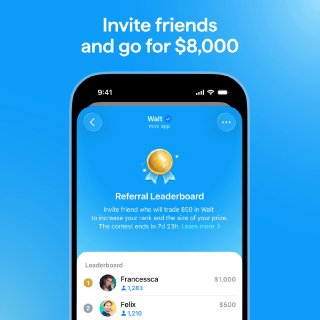
🏆 Invite friends: $8,000 in prizes every week
A two-week referral competition is now live in Walt. Each week’s leader wins $1,000, and just one friend is enough to compete for prizes.
How it works:
• Send a friend your referral link.
• They count once they make any trade of $50 or more.
• Each week, prizes go to the 50 participants who bring the most friends: $1,000, $700 and $500 for the top three, and $300 down to $50 for the rest.
🏅Everyone else on the Leaderboard enters a draw where 30 participants win $50 each.
🗓 Week one runs until October 30. The full prize table, Leaderboard and results are in Walt Rewards.
Community | X | Support
A two-week referral competition is now live in Walt. Each week’s leader wins $1,000, and just one friend is enough to compete for prizes.
How it works:
• Send a friend your referral link.
• They count once they make any trade of $50 or more.
• Each week, prizes go to the 50 participants who bring the most friends: $1,000, $700 and $500 for the top three, and $300 down to $50 for the rest.
🏅Everyone else on the Leaderboard enters a draw where 30 participants win $50 each.
🗓 Week one runs until October 30. The full prize table, Leaderboard and results are in Walt Rewards.
Community | X | Support
❤
21
👍
5
🔥
3
🍾
3
⚡
1
Пост от 21.10.2026 18:11
15 472
0
5
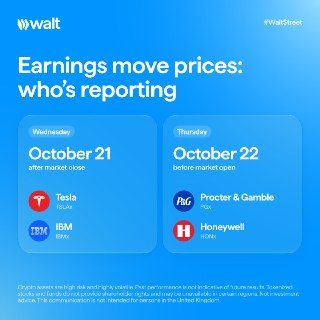
↗️ Earnings move prices: follow them with the latest Walt updates
Tesla, IBM, Procter & Gamble and other major US companies report earnings today and tomorrow. Their tokenized stocks are available on Walt, along with 60+ other companies.
An earnings report can move a stock sharply in either direction, and it often comes out after the market closes. On Walt, many tokenized stocks trade 24/7.
⭐️ With the latest #WaltStreet updates, you can add these assets to your watchlist to track them on the home screen, and get analytics on them from @mira.
Walt. Built for people who follow the markets.
Community | X | Support
Tesla, IBM, Procter & Gamble and other major US companies report earnings today and tomorrow. Their tokenized stocks are available on Walt, along with 60+ other companies.
An earnings report can move a stock sharply in either direction, and it often comes out after the market closes. On Walt, many tokenized stocks trade 24/7.
⭐️ With the latest #WaltStreet updates, you can add these assets to your watchlist to track them on the home screen, and get analytics on them from @mira.
Walt. Built for people who follow the markets.
Community | X | Support
👍
61
❤
47
🍾
46
🙏
42
🫡
38
Пост от 21.10.2026 15:32
14 994
2
8
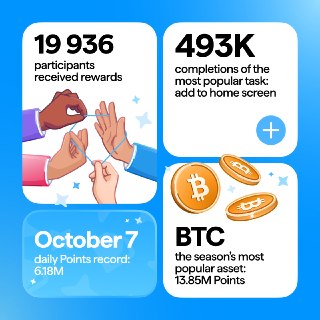
🏆 Season 3 results
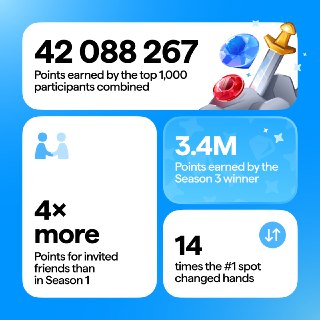
The autumn season is over, and it was our most dynamic one yet: first place on the Leaderboard changed hands 14 times, and the top 1,000 participants earned over 42 million Points. More stats in the images above.
🎉 If you finished in the Leaderboard’s Top 500, congratulations: you’ve secured a prize. 500 more participants with 1,000+ Points will win $100 each in a prize draw. Winners will be announced next week in a dedicated channel.
All rewards will be sent by the end of October.
🎁 Meanwhile, auctions are still running: keep earning Points, spend them on gifts and compete for lots.
Thanks for a great season ❤️
Community | X | Support
The autumn season is over, and it was our most dynamic one yet: first place on the Leaderboard changed hands 14 times, and the top 1,000 participants earned over 42 million Points. More stats in the images above.
🎉 If you finished in the Leaderboard’s Top 500, congratulations: you’ve secured a prize. 500 more participants with 1,000+ Points will win $100 each in a prize draw. Winners will be announced next week in a dedicated channel.
All rewards will be sent by the end of October.
🎁 Meanwhile, auctions are still running: keep earning Points, spend them on gifts and compete for lots.
Thanks for a great season ❤️
Community | X | Support
❤
2
👍
73
🫡
47
⚡
29
🔥
28
Пост от 20.10.2026 16:21
38 179
0
60
⭐️ Your AI perps assistant on Walt Street · 3/5
Walt is opening up a new way to trade: for the first time in Telegram, an AI agent supports you at every step. You can now get the picture on the market, open a position and check your portfolio risk in one chat, without switching screens. Your agent works with perpetuals and places every trade only once you confirm.
🧠 Connect the AI you already use
Connect ChatGPT, Claude, Grok, Cursor or any other AI agent. Or use @mira, right in Telegram.
⚡️ Your agent gets its own account
You decide how much goes in. The agent can’t withdraw funds, and you can disconnect it at any time.
✅ How to get started:
• Open Walt
• On the home screen, tap “Create AI agent account”
• Pick your agent and connect it
Which agent will you connect first? Let us know in the comments.
This is the third of five Walt Street updates. Earlier, we showed you how to keep your favorite assets within reach and how to pay less in fees. #WaltStreet
Investments in crypto are risky. This communication is not intended for persons in the United Kingdom.
1 • 2 • 3 • 4 • 5
Walt is opening up a new way to trade: for the first time in Telegram, an AI agent supports you at every step. You can now get the picture on the market, open a position and check your portfolio risk in one chat, without switching screens. Your agent works with perpetuals and places every trade only once you confirm.
🧠 Connect the AI you already use
Connect ChatGPT, Claude, Grok, Cursor or any other AI agent. Or use @mira, right in Telegram.
⚡️ Your agent gets its own account
You decide how much goes in. The agent can’t withdraw funds, and you can disconnect it at any time.
✅ How to get started:
• Open Walt
• On the home screen, tap “Create AI agent account”
• Pick your agent and connect it
Which agent will you connect first? Let us know in the comments.
This is the third of five Walt Street updates. Earlier, we showed you how to keep your favorite assets within reach and how to pay less in fees. #WaltStreet
Investments in crypto are risky. This communication is not intended for persons in the United Kingdom.
1 • 2 • 3 • 4 • 5

❤
1
🔥
284
🍾
186
🙏
161
🦄
129
Пост от 19.10.2026 16:24
38 767
0
28
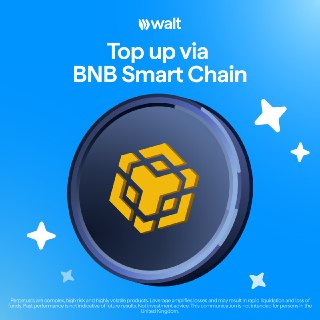
💸 Top up your balance via BNB Smart Chain
You can now send BNB, USDT and USDC to Walt via BNB Smart Chain (BSC).
BNB is also live on spot. In October 2025, it hit an all-time high of $1,370, and today it trades at around $730. That’s almost 4,900 times what the first buyers paid in 2017.
👀 Why BNB stands out today
● Ranks 4th by market cap among all cryptocurrencies
● Used to pay fees on BNB Chain
● Every quarter, part of the supply is burned, so the total number of coins keeps shrinking
On Walt, you can buy BNB on spot or open a Perpetuals position in the Trading section. Start from $1, trading is open 24/7.
Community | X | Support
You can now send BNB, USDT and USDC to Walt via BNB Smart Chain (BSC).
BNB is also live on spot. In October 2025, it hit an all-time high of $1,370, and today it trades at around $730. That’s almost 4,900 times what the first buyers paid in 2017.
👀 Why BNB stands out today
● Ranks 4th by market cap among all cryptocurrencies
● Used to pay fees on BNB Chain
● Every quarter, part of the supply is burned, so the total number of coins keeps shrinking
On Walt, you can buy BNB on spot or open a Perpetuals position in the Trading section. Start from $1, trading is open 24/7.
Community | X | Support
❤
1
👍
281
🙏
159
🍾
136
🦄
94
Пост от 15.10.2026 16:24
36 570
13
31
💎 Top up Money from Walt
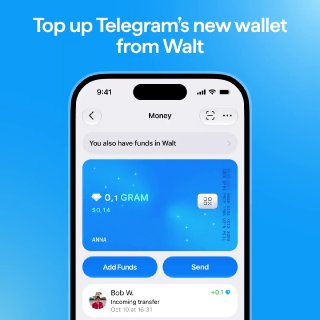
Telegram has a new wallet called Money. You can top it up from your Walt balance, and GRAM arrives in seconds.
💰 Just three steps:
● Open Money and tap “Add Funds” → “Buy with cash or crypto”
● In Walt, choose “Deposit from Walt”
● Enter the amount and confirm
Don’t see “Deposit from Walt”? That means there’s no GRAM on your Walt balance, or all of it is in Earn. You can buy GRAM in Walt with a card or crypto, or on P2P Market.
Money is also a quick way into Walt: tap the “You also have funds in Walt” banner at the top of the screen.
⭐️Money for GRAM. Walt for your whole portfolio.
Investments in crypto are risky. This communication is not intended for persons in the United Kingdom.
Community | X | Support
Telegram has a new wallet called Money. You can top it up from your Walt balance, and GRAM arrives in seconds.
💰 Just three steps:
● Open Money and tap “Add Funds” → “Buy with cash or crypto”
● In Walt, choose “Deposit from Walt”
● Enter the amount and confirm
Don’t see “Deposit from Walt”? That means there’s no GRAM on your Walt balance, or all of it is in Earn. You can buy GRAM in Walt with a card or crypto, or on P2P Market.
Money is also a quick way into Walt: tap the “You also have funds in Walt” banner at the top of the screen.
⭐️Money for GRAM. Walt for your whole portfolio.
Investments in crypto are risky. This communication is not intended for persons in the United Kingdom.
Community | X | Support
❤
3
👍
302
✍
187
🙏
152
🔥
135
Пост от 14.10.2026 15:15
34 704
13
7
❤
6
🦄
303
👍
174
🙏
163
⚡
125